

RESEARCH
Glycan Structural Analysis Division
Purpose / Contents
Elucidation of glycan functions by determining the structure of glycan and related molecules
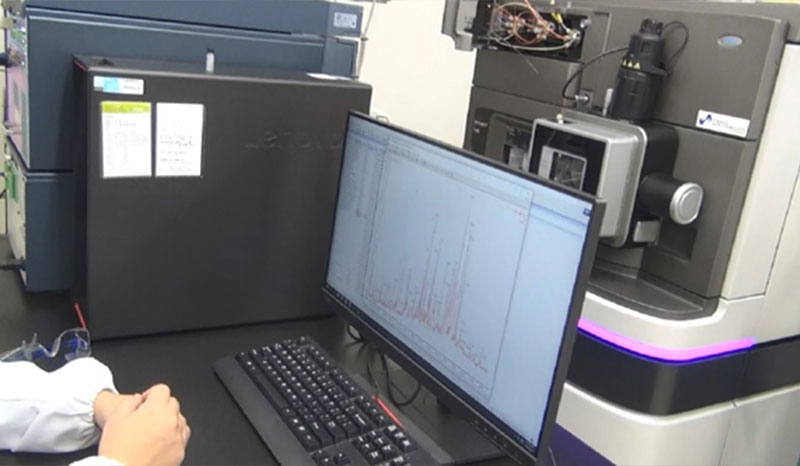
The goal of Structural Analysis Division in the Integrated Glyco-Big Data Center (iGDATA) is to analyze the detailed structures of glycans and related molecules and to collect such information to elucidate glycan functions and develop glycan-targeted diagnoses. To achieve this, we perform structural analysis of glycans and related molecules from cells or tissue samples using MS. We utilize LC-MS, MALDI-MS, and NMR for this purpose. Additionally, we aim to develop novel technologies for automatic glycan analysis, enabling researchers to easily analyze glycan structures from multiple samples. With these approaches, we aim to obtain glycan information that can be useful for both disease diagnosis and a better understanding of life.
Examples
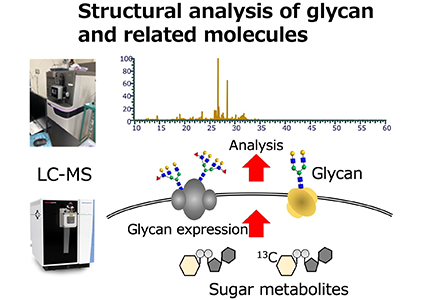
Analysis of glycan-related molecules
Using a combination of MS, NMR, and computational analysis, our objective is to clarify the structures and dynamics of individual glycans and related metabolites. Integrating the structures and dynamics of each glycan will result in a comprehension of the mechanisms of biological processes regulated by glycans.
Members List
Morten Thaysen-Andersen
Structural Analysis Division
- Research interests
- Clinical glycoproteomics, Glycoimmunology, N-glycosylation, Cancer, Sepsis, Innate immunity
- Research subject
- The Glycoproteomics Lab@iGCORE develops and applies cutting-edge LC-MS/MS-based methods for quantitative and comparative glycoproteomics of human biospecimens to holistically explore elusive roles of protein N-glycosylation in human glycobiology with a particular focus on the innate immune system. The group uses high throughput glycoproteomics methods compatible with large clinical sample cohorts to study how the N-glycoproteome is remodelled with aberrant physiology and with various disorders including cancer, inflammation and infectious diseases.
Hiroyuki Kaji
Division headStructural Analysis Division
- Research interests
- Glycoproteomics, glycome, proteome, liquid chromatography, mass spectrometry
- Research subject
- We develop and apply techniques for comprehensive analysis of post-translational modifications of proteins, especially glycosylation, using mass spectrometry. We systematically analyze the structures of glycans attached to the glycosylation sites on each glycoprotein in biological samples such as body fluids, cells, and tissues, and when and how these glycans change. By obtaining this information, we hope to contribute to basic research such as elucidation of the involvement of glycans in biological phenomena as well as applied research on development of diagnostic markers and therapeutic targets presenting the altered glycans.
Jennifer Jean Kohler
Structural Analysis Division
- Research interests
- chemical biology, fucose, glycolipids, intestinal epithelia, mucus, infectious disease, genetic disorders of glycosylation
- Research subject
- The complex structures and properties of glycans are critical to their myriad biological functions. However, this complexity leads to technical challenges. To tackle these challenges, our research team has created chemical biology methods aimed at understanding glycan function. In particular, we developed photocrosslinking sugar analogs that can be metabolically incorporated into cellular glycoconjugates and used to covalently capture transient glycan-mediated interactions. Using one of these photocrosslinking sugars, we discovered that cholera toxin recognizes fucosylated glycoconjugates displayed on the surface of human intestinal epithelial cells. In current work, we are continuing to develop and apply chemical biology tools to problems in glycoscience. Additionally, we are probing the mechanisms that regulate production of glycoconjugates that comprise the mucosal layer of the intestinal epithelial. Our studies have relevance to infectious disease, cancer biology, and genetic disorders of glycosylation.
Jun-ichi Furukawa
Structural Analysis Division
- Research interests
- Glycomics, glycoprotein, glycosphingolipid, glycosaminoglycan, free oligosaccharide, SALSA method
- Research subject
- Cell surface is covered with various glycans whose levels and structures are known to change dramatically with cellular conditions and the environments. Various classes of glycans are present, including complex glycoconjugates such as glycoproteins and glycolipids, glycosaminoglycans such as heparan sulfate and chondroitin sulfate, and free oligosaccharides. We have developed a technique for comprehensive analysis of glycans and conduct total glycomics research on blood, cells, and tissues.
Rebeca Kawahara
Structural Analysis Division
- Research interests
- Clinical glycoproteomics, multi-omics, data integration, glycosignatures, diseases
- Research subject
- The focus of my research at the Glycoproteomics Lab@iGCORE consists in developing and applying advanced mass spectrometry-based glycoanalytical methods and multi-omics data integration systems in large cohorts of clinical samples to enable comprehensive and holistic profile of the human glycoproteome and the discovery of new glycosignatures associated with human diseases.
Hisatoshi Hanamatsu
Structural Analysis Division
- Research interests
- Glycan analysis, mass spectrometry, sialic acid
- Research subject
- To easily analyze various classes of complex glycoconjugate glycans in cells, tissues, and body fluids, we focus on the development of new subglycome analysis techniques, such as a chemical approach to identify sialic acid linkage patterns by mass spectrometry, a chemical cleavage method for O-type glycans without useful cleavage enzymes, and a new separation method for glycosaminoglycan disaccharides, to elucidate various glycan functions.
Shiori Go
Structural Analysis Division
- Research interests
- Glycolipid, glycoproteomics, intracellular trafficking
- Research subject
- We focus on the function of membrane microdomain in various biological phenomena on brain. In membrane microdomain, glycosphingolipids and specific glycoproteins are enriched, interact with each other, and regulate various biological functions. We are particularly interested in the elucidation of comprehensive functions of microdomains glycosylation in neural functions. We analyze structure of glycosphingolipids and glycans of glycoproteins in microdomain using methods for glycoproteomics and glycosphingolipids analysis.
Huang Chengcheng
Structural Analysis Division
- Research interests
- Chemical glycobiology, Sialic acid, free oligosaccharides, serum
- Research subject
- My work at iGCORE focuses on incorporating chemically labeled glycan analogs into animal cells for in vivo functional studies of glyconjugates. In particular, I use photocrosslinking sialic acid analogs so that the modified glycans can be used to covalently capture transient glycan-mediated interactions. I also aim to develop novel click chemistry method for the fluorescent labeling of sialic acid in animal cells. My research interests also include the structural analysis of free oligosaccharides in serum and their potential biological functions.
Priya DIPTA
Structural Analysis Division
- Research interests
- Glycoimmunology, Molecular Biology, Immunology, Cancer, Pharmacology, N-glycosylation
- Research subject
- I have joined the Glycoproteomics Lab@iGCORE to contribute towards the HGA goal by utilizing various analytical methods. My research focuses on mapping glycosylation in immune cells and the tumour microenvironment, aiming to uncover its functional implications in inflammation and cancer biology.
Yann Guerardel
Division headStructural Analysis Division
- Research interests
- Glycomics、Structural analysis、Host-pathogen interactions、NMR、Mass Spectrometry
- Research subject
- I am a senior researcher for CNRS (Lille University, France) and an Invited Professor at iGCORE (Gifu University, Japan). I focus my research on the structure to function relationships of complex carbohydrates, from microorganisms to higher eukaryotes, mostly in the context of host-pathogen interaction. My main objective is to understand how the glycans from both host and pathogen fine tune the infectious process and how they may be used as diagnosis or therapeutic tools, with a keen interest for mycobacterial, fungus and viral infections. To reach this goal, I integrate a wide range of scientific approaches including synthetic chemistry, structural analysis using NMR spectroscopy and mass spectrometry, structural biology of proteins and enzymology.
Kazuki Nakajima
Structural Analysis Division
- Research interests
- Glycoproteomics, nucleotide sugar, automatic analysis
- Research subject
- We develop analytical techniques for rapid glycoproteomics and metabolomics to elucidate metabolic relationships between glycoproteins and glycans, and nucleotide sugars. High-throughput methods using chromatography and mass spectrometry will be established to promote analysis of large cohorts. In particular, by integrating robotics and systems through collaboration, we aim to fully automate plasma glycoproteomics, which has been difficult to achieve so far. In the future, we hope to discover glycan-related biomarkers for neurodegenerative and renal diseases and propose a new diagnostic system.
Research Division
Contact us by phone
Gifu University

058-293-3754
( +81-58-293-3754 )
Weekday, 9:00-17:00
Nagoya University
052-789-5365
( +81-52-789-5365 )
Weekday, 9:00-17:00
Contact us

 DOWNLOAD